
Turn your human network into an HR, CSR and employer brand asset
Former employees, experienced team members, internal mentors and engaged nonprofit partners represent a strategic human asset. Yet in many organizations, this asset remains scattered, underused or difficult to showcase.
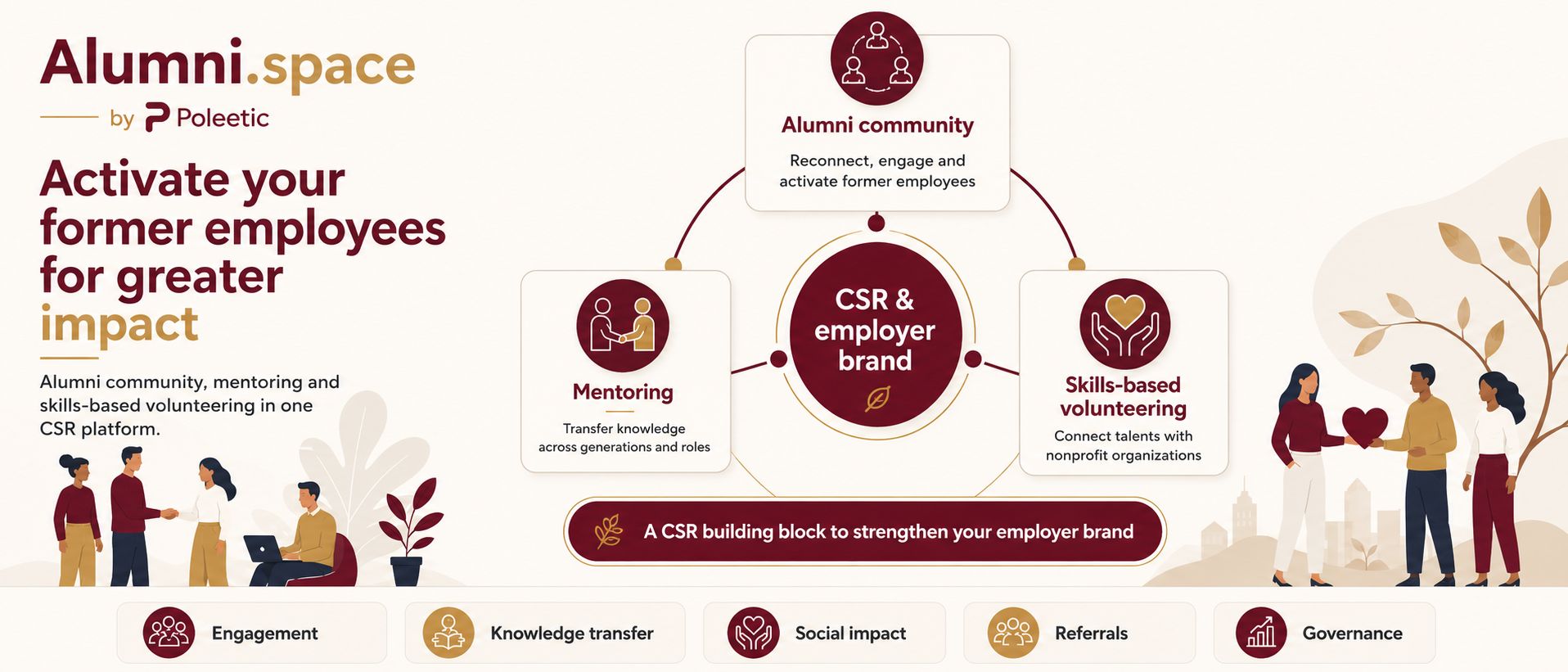
Alumni.space was designed to structure this relationship over time. The platform is built around three complementary pillars: a digital community for former employees, an internal or external mentoring solution, and a future connection layer with nonprofit organizations to facilitate skills-based corporate volunteering.
The goal is simple: to turn an existing human network into a concrete lever for engagement, knowledge transfer, social responsibility and employer branding.
Alumni.space is therefore not just a community platform. It is an operational CSR building block, serving human resources, employer brand strategy and social impact.
The activity
Alumni.space is a turnkey SaaS platform designed to create, engage and promote communities of former employees, mentors, engaged employees and nonprofit partners.
The first pillar is the former employee community platform, available at www.alumni.space. It enables companies, schools, nonprofit organizations and public-sector organizations to centralize their network in a lively, controlled and branded space. Former employees are no longer scattered across Excel files, outdated directories or underused LinkedIn groups. They have a dedicated space to update their profile, follow news, join events, view opportunities, recommend talent and stay connected to the organization.
The second pillar is the mentoring platform, available at mentor.alumni.space. It makes it possible to organize internal or external mentoring programs. Internally, it supports knowledge transfer between experienced employees, young talents, new joiners, managers and employees in career transition. Externally, it allows alumni, experts, volunteers or partners to support students, graduates, entrepreneurs, people in career change or beneficiaries of inclusion programs.
The third pillar, planned for launch in September 2026, is a connection layer with nonprofit organizations designed to facilitate skills-based corporate volunteering. In France, this mechanism is known as “mécénat de compétences”: a company makes employees available, during their working time, to support an organization serving the public interest. It can take the form of a service provision or a nonprofit staff secondment, while the employee remains employed and paid by their original company.
This future building block will aim to connect available skills within companies with the concrete needs of nonprofit organizations: communication, digital strategy, HR, project management, administrative support, professional mentoring, technical assistance or experience sharing.
Alumni.space therefore structures three complementary dimensions: relationships with former employees, knowledge transfer and social engagement through skills.
The target audience
Alumni.space is designed for organizations whose value depends on people, knowledge sharing and the ability to activate a network over time.
For companies, the platform makes it possible to create a former employee community, maintain relationships after departures, strengthen referrals, run mentoring programs and prepare skills-based corporate volunteering initiatives. HR, CSR, internal communication and employer brand teams can rely on a common foundation to manage engagement, retention, knowledge transfer and impact.
For schools, universities and training organizations, Alumni.space helps structure alumni networks, support employability, develop mentoring between cohorts and showcase graduate career paths. The alumni network becomes living proof of employability, success and attachment to the institution.
For nonprofit organizations, foundations and endowment funds, the platform opens up an important opportunity: easier access to qualified skills from the business world, within a structured, monitored and measurable framework.
For works councils and internal networks, Alumni.space can also become a community engagement tool: events, mutual support, skill sharing, collective initiatives, volunteering or engagement programs.
The pain
Many organizations already have a valuable network, but it often remains invisible or difficult to activate.
Former employees leave with part of the organization’s history, know-how and relationship capital. Experienced employees rarely have a clear space to pass on their knowledge. Nonprofit organizations need concrete skills, but often struggle to reach the right profiles. HR and CSR teams want to demonstrate their impact, but lack simple tools to monitor, document and showcase their actions.
The issue is therefore not the absence of a network. The issue is the absence of structure.
Without a dedicated platform, contacts become outdated, communities lose momentum and initiatives rely on manual files. LinkedIn groups can create an initial connection, but they do not provide data ownership, governance or impact indicators. Excel files can store names, but they do not create community dynamics.
This fragmentation has a cost: loss of skills, low alumni engagement, missed recruitment opportunities, mentoring programs that are difficult to track, poorly visible CSR initiatives and an underused employer brand.
The gain
With Alumni.space, the network becomes a living, useful and measurable asset.
The community platform helps maintain relationships with former employees, showcase career paths, share news, organize events and create referral or collaboration opportunities. The company no longer fully loses contact with those who contributed to its story.
The mentoring platform makes knowledge transfer tangible. It facilitates connections between mentors and mentees, both internally and externally. It can support onboarding, internal mobility, intergenerational knowledge transfer, career development or support for external audiences.
The future skills-based corporate volunteering layer, planned for September 2026, will add a further CSR dimension. It will make it possible to connect available skills with real nonprofit needs. Engagement will no longer remain purely declarative: it will become actionable, traceable and measurable.
For employer branding, the benefit is direct. An organization that maintains relationships with former employees, values its mentors, supports knowledge transfer and puts its skills at the service of public-interest causes sends a strong signal. It shows that human relationships do not end with the employment contract.
Alumni.space therefore helps strengthen attractiveness, retention, employer reputation and CSR proof points.
Positioning within the Poleetic ecosystem
Alumni.space is part of a broader vision led by Poleetic: helping organizations take back control of their digital assets, communities and visibility.
While Poleetic supports digital strategy, SEO, web governance, AI/GEO visibility and performance measurement, Alumni.space brings an essential relationship layer: the ability to structure and activate a human network.
This building block is strategic because it does not rely solely on traffic acquisition, advertising or search engines. It is based on an asset the organization already owns: its former employees, collaborators, mentors, partners and communities.
Alumni.space promotes a clear approach: no advertising, no excessive dependence on social platforms, no opaque data capture. The organization keeps control of its network, content, indicators and actions.
In this logic, Alumni.space becomes a tool at the crossroads of HR, CSR, internal communication, employer branding, mentoring and skills-based corporate volunteering.
Our vision for the future
Tomorrow’s most attractive organizations will not only be those that recruit quickly. They will be those that know how to build relationships over time, transfer knowledge, mobilize former employees, support their talents and put their skills to work for the public interest.
Alumni.space responds to this shift. The platform makes it possible to move from a dormant network to an active community. It turns former employees into ambassadors, experienced collaborators into mentors, internal skills into useful resources for nonprofit organizations, and CSR initiatives into concrete proof points.
This is a new way to think about employer branding: less declarative, more relational, more measurable and more useful.
Take action
Your network already exists. Your former employees, collaborators, mentors and future nonprofit partners can become a powerful lever for engagement, knowledge transfer and impact.
With Alumni.space, you can structure this human capital in a dedicated space, launch your first mentoring programs and prepare a more concrete CSR approach around skills-based corporate volunteering.